I. The Pressure of the Canvas
The heat of the desert did not vanish when the sun sank below the horizon; it merely changed form. By day, it was a blinding, incandescent hammer. By night, it trapped itself beneath the thick, sun-baked weave of the forward operating base’s canvas tents, turning the cramped quarters into a heavy, suffocating blanket.
Inside Command Tent Four, Sergeant Amy Vance lived in a world measured not by miles, but by megahertz.
For six long months, her universe had been reduced to three sensory constants: the perpetual, fine grit of sand between her teeth, the faint smell of hot circuit boards mixed with damp canvas, and the soft, ghostly green phosphor glow of tactical displays.
To the grunts outside who dragged their boots through the dust on perimeter watch, Amy was known simply as the “Ghost of the Comms.” She had earned the moniker not through mystery, but through sheer, impossible skill. When radio waves shattered against jagged granite peaks, when solar flares turned high-frequency bands into shrieking white noise, or when weather systems suffocated standard relays, Amy was the one who could reach into the electromagnetic soup and pull out a whisper of clear signal. She knew the mood of the ionosphere the way a sailor knew the ocean tides.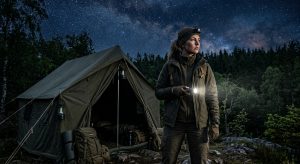
Yet, despite her quiet authority over the airwaves, the true drama of her deployment wasn’t written in the frantic skirmishes along the perimeter wire, nor in the air-strike callouts she routed. It was written in the silence of her personal gear bag—specifically, in a stack of unfinished letters resting at the bottom of a battered olive-drab rucksack. Letters to her mother, to her sister, to a life that felt a million light-years away. Every few nights she would pull out a pen, write a line or two, and stop. How do you explain the weight of this place to someone who sleeps in a bedroom with wooden floors? She couldn’t bring herself to seal them, so they remained, silent witnesses to her isolation.
Her tent was sparse. Supply crates—rough-cut pine stamped with black stencil codes—served as her desk, her dining table, and her sanctuary. Upon them sat her diagnostic tools, her standard-issue laptop, a small battery-powered fan that did little more than move the warm air around, and her prized possession: a faded, laminated photograph of a quiet porch back home in Ohio.
On a Tuesday night, while the rest of the outpost drifted into a rare, uneasy sleep under a moonless sky, Amy sat hunched over a half-finished tactical map illuminated by the pale green wash of her display monitor.
The silence was shattered by the sharp crackle of a high-priority distress feed.
II. The Trap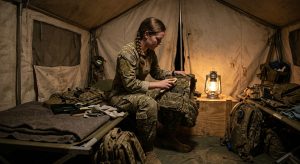
The intel was a bloody mess.
Three hours prior, a two-man reconnaissance unit had suffered a catastrophic engine failure—or had taken ground fire, nobody was sure yet—and made a forced landing deep inside Sector Nine. The pilot was alive, barricaded in a shallow drainage cut, but he was pinned down and running out of battery power on his survival radio. To make matters worse, thermal imaging showed a massive sandstorm gathering fifty miles to the west, sweeping across the desert like a wall of dark iron. They had a window of perhaps six hours before the air support would be grounded and the pilot swallowed by the storm.
Amy sat at her comms rig, her fingers flying across the keys, listening to the static-drenched voice of the pilot fading in and out.
“…Base, this is… Overlord-Two… radio power down to twelve percent… storm front visible on… south ridge… do you copy…”
“Copy, Overlord-Two,” Amy spoke into her headset, her voice calm, a steady tether in the dark. “Hold your position. We are mapping your extract now.”
Across the base, in the Command Information Center (CIC), the senior officers had gathered around the main digital sandtable. Colonel Thomas Miller—a tall, iron-jawed officer whose uniform seemed permanently starched despite the ninety-degree ambient heat—stood at the head of the table. Miller was a strategist who managed operations with the cold precision of an accountant balancing ledgers. To him, terrain was a variable, timelines were absolute, and soldiers were assets to be moved across a grid.
“We take the northern pass—Route Kilo,” Colonel Miller declared, pointing a gloved finger at a narrow blue line on the digital display. “It’s the fastest terrestrial vector. Motorized infantry in armored transport can reach his coordinates in ninety minutes, load him up, and beat the dust wall back to base.”
Amy, who had walked into the back of the briefing tent with a fresh printout of atmospheric telemetry, froze.
She looked at Route Kilo on the map. Her pulse quickened. “Sir,” she spoke up, her voice cutting through the hum of the air scrubbers.
Miller turned, his eyebrow rising slightly. “Sergeant Vance. You have something to add?”
“Route Kilo crosses the lower basin of the Al-Zuhar valley, Colonel,” Amy said, stepping closer to the table. “Our satellite feeds are thirty-six hours old because of the cloud cover coming off the mountains. But I’ve been tracking regional meteorological feeds. It rained thirty inches in the upper highlands two days ago.”
“Rain in the highlands doesn’t affect a gravel road in the valley, Sergeant,” Miller said dryly.
“It does if that road is an alluvial flood plain, sir,” Amy insisted, placing her hand on the edge of the digital map. “The ground there turns to deep clay slurry when it saturates. Worse—the insurgent networks used that specific corridor to lay anti-vehicle mines three months ago. If the upper layer of soil washed away in a flash flood, those mines have drifted into the wash. It’s not just an impassable mud pit, Colonel. It’s an active flood plain turned into an untraceable minefield.”
Miller looked at her for a long moment. His face was unreadable, carved from cold stone. He glanced back at his intelligence officer, who offered a small, hesitant shrug.
“Our primary intel feed shows Route Kilo as clear and dry as of Tuesday morning, Vance,” Miller said, his tone dropping an octave. “We don’t have time to reroute twenty miles south over the mountain tracks—we’ll hit the dust storm before we reach the pilot. We go through the pass.”
“Sir, the risk—”
“Follow the coordinates, Vance,” Miller cut her off, stepping closer until he towered over her. “You monitor the radio traffic and keep that pilot talking. Leave the tactical routing to command. That is an order.”
The words hung in the air, heavy and sharp. Amy felt a cold knot tighten in her stomach. She looked at the Colonel, then at the map, seeing not just blue lines and topographic curves, but five men in an armored vehicle driving blind into a wall of mud and buried high explosives.
“Understood, sir,” she whispered.
III. The Forty-Eight Hour Vigil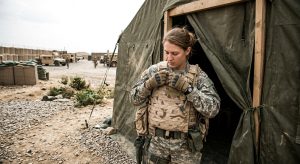
She walked back to her tent, her boots striking the dirt in a rhythm that matched the hammering in her chest.
The conflict tore at her with a physical violence. Military discipline was built on a single premise: trust the chain of command. If every sergeant questioned every colonel, the entire machine would fall apart. If she stayed silent, she was being a good soldier.
And if I stay silent, she thought, looking down at her hands, men are going to burn in that valley.
If she stayed silent, she was complicit. If she spoke up again without proof, she was insubordinate, facing a court-martial, a stripped rank, and a dishonorable discharge.
She sat on the edge of a pine crate, leaning her elbows on her knees, staring at her dirt-streaked boots. The silence of the tent felt heavier than any eighty-pound rucksack she had ever strapped to her back.
In the dim green light, her eyes drifted to her dog tags sitting beside the radio terminal, and beyond them, the memory of her father’s voice crept into her mind.
Her father had been a quiet man who walked with a limp—a legacy of a muddy jungle half a world away, a conflict decades past. He had returned from his war with his body intact, but his soul left somewhere beneath a canopy of wet trees. He had rarely talked about the fighting, but one evening, sitting on that quiet porch in Ohio while the crickets hummed, he had looked at young Amy and said something she had never forgotten:
“The uniform tells you how to stand, Amy, but your gut tells you how to live. If the uniform ever asks you to trade your soul to save your skin, you tear the sleeve off.”
Amy took a deep, shaky breath. She let it out slowly. Her hands stopped trembling.
She reached for her headset, slid it over her ears, and leaned over her keyboard.
She didn’t just speak up—she stayed up.
What followed was a forty-eight-hour war waged in the electromagnetic spectrum. Amy refused to sleep. She fueled herself on lukewarm, bitter instant coffee and sheer defiance.
While the command staff relied on standard military satellite packages that were lagging due to the storm, Amy went rogue. She pulled up old, open-source weather telemetry from forgotten meteorological stations scattered across the Middle East. She bypassed standard channels and tapped into legacy shortwave frequencies—listening to the low-bandwidth chatter of local herdsmen and ancient insurgent radio bands that had been dormant for months.
For hours, her eyes burned as she cross-referenced atmospheric pressure data, topographical elevation models, and radar backscatter images. She wrote complex algorithms on scrap paper to calculate the exact flow rate of water down the Al-Zuhar watershed, mapping the path the floodwater would take across the gravel road.
By hour thirty-six, her vision was swimming with red veins, her legs were cramped, and her brain felt like dry paper. But there, spread across three overlapping monitors, was the undeniable, mathematical truth.
The rainfall in the mountains had indeed caused a flash flood twelve hours ago. The water had crested, carrying three feet of dense silt down into the valley, submerging Route Kilo. Worse, her signal triangulation of local insurgent chatter confirmed that the shift in the earth had displaced dozens of buried ordnance items, washing them directly into the center of the pass.
It wasn’t a speculation anymore. It was a death trap, documented in indisputable data.
IV. The Truth in the Tent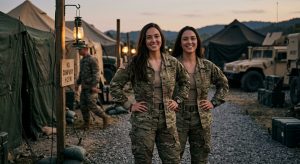
At 0400 hours, two hours before the rescue team was scheduled to roll out, Amy stood up from her crate. Her knees popped in the quiet tent. Her uniform was stained with sweat and yellowed by dust, her eyes were bloodshot, but her spine was straight.
She printed the consolidated data maps, grabbed her tablet, and walked back to the CIC.
The command tent was buzzing with pre-mission tension. Operators were checking gear, maps were being drawn, and Colonel Miller was standing over the tactical sandtable, adjusting a pair of reading glasses.
Amy walked straight through the outer flap. She didn’t ask for permission to speak. She didn’t wait to be recognized.
“Colonel,” she said. Her voice was flat, dry, and sharp as a razor.
Miller turned, irritation flaring in his eyes. “Sergeant Vance, I thought I made myself clear—”
Amy stepped right up to the table, slapped the printed telemetry maps directly over the tactical display, and laid her tablet beside them.
“Route Kilo is underwater, sir,” she said, her voice dropping into a register that commanded the room. The chatter in the CIC died instantly. Radios hissed in the background, but no one spoke. “This is real-time synthetic-aperture radar data pulled from a European civilian satellite pass thirty minutes ago. This second overlay shows the water convergence zone.”
She pointed a thin finger at the paper. Her hand did not shake.
“The flood plain washed out the main access road three hours ago. The mud depth is currently four feet, saturated with clay. Furthermore, I’ve intercepted low-frequency insurgent communications confirming that at least eight pressure-plate mines have been dislodged from the upper ridges and are currently floating or buried in the mud along a three-hundred-meter stretch of the pass. If you send the convoy down Route Kilo, the lead vehicle will sink, detonate a mine, and block the pass. You will lose the convoy, you will lose the rescue team, and the pilot will die in the storm.”
Miller stared at the paper. He looked at the high-density data, the satellite signatures, the thermal reads. He looked at the undeniable, meticulously gathered evidence laid out before him.
Then, he looked up at Amy.
She stood in that humid, cramped tent, her red-rimmed eyes locked onto his. She didn’t shrink back. She didn’t look down at her boots. She didn’t just give him a map; she gave him the truth, stripped of rank, ego, or military politics.
For five agonizing seconds, the only sound in the tent was the hum of the generator outside.
Miller swallowed hard. The rigidity in his posture seemed to yield, just a fraction, under the weight of her conviction. He reached out, picked up the printout, and studied it for a long, quiet moment.
“Operator,” Miller said quietly, looking up at his navigation officer. “Re-route the extraction team through the eastern ridge line. Route Delta.”
“Sir, Route Delta is longer,” the officer hesitated. “We’ll be cutting the storm window down to minutes.”
“Then tell them to drive fast,” Miller said, his voice quiet. He looked back at Amy, offering a slow, barely perceptible nod. “Good work, Sergeant. Dismissed.”
V. The Quiet Hours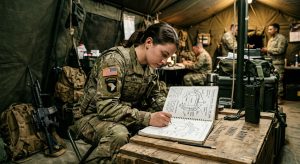
The rescue mission took four grueling hours.
Amy sat at her station the entire time, her fingers resting lightly on her comms desk, guiding the extraction team through the jagged terrain of Route Delta, around the edge of the storm, and straight to the downed pilot’s coordinates.
At 0830 hours, as the first dark, dust-laden gusts of the approaching storm began to rattle the canvas walls of the FOB, the radio crackled to life.
“Base, this is Rescue-One… package secured. Repeating, pilot is on board. We are coming home.”
Exhaustion finally hit Amy like a physical blow. She lowered her headset to the desk, leaned back against a wooden crate, and closed her eyes.
There were no awards presented to Sergeant Vance that week. There was no formal accommodation placed in her file, no speeches made in the mess hall, no medals pinned to her chest. In the official logs, the route change was recorded simply as an “operational adjustment due to environmental factors.”
Two days later, after the sandstorm had finally blown itself out and left the camp bathed in a stark, clean morning light, Amy was sitting outside her tent on an inverted wooden crate, cleaning the sand out of her keyboard with a small brush.
A tall man with his arm in a sling and a thick layer of white gauze wrapped around his forehead walked slowly down the central aisle of the encampment. He wore a flight suit, stripped of its gear, looking pale and battered.
As he passed Amy’s tent, he slowed his pace. He didn’t stop. He didn’t ask her name. He simply turned his head, caught her eye, and gave her a long, quiet nod of absolute understanding—a nod from one survivor to the person who had pulled him back from the grave.
Amy returned the nod, a small, subtle movement of her chin.
She watched him walk toward the medical tent, then turned back to her wooden crate. She pulled out her stack of unsent letters, picked up her pen, and finally began to write:
Dear Mom,
It’s hot here, and the sand gets into everything. But today, the sky is clear…
She smiled faintly, dipping her pen in the ink, knowing that in the vast, brutal theater of war, the hardest and most important battles are never fought on the open battlefield, but in the lonely, silent hours between the crates and the canvas.